
I just took my first shower in ~2 weeks (stitches came out on Friday). Man, did that feel good!! Our upstairs shower broke 4 years ago — I told hubby he had to get it fixed by May 22…and that is the day it got done!
June 5, 2011
June 2, 2011
From Both of Us — Nuppified
Nuppified (rhymes with stupified): to be overcome by the desire to knit nupps; the act of knitting nupps; an incurable form of insanity
We have both been nuppified. We are either in the process of or shortly finished with nupp-filled projects.
From Susan
In my convalescence, I have been focusing on smaller projects and have finished two of them. I will share the second one first! I stumbled upon a really lovely pattern on Ravelry (another freebie no less!) and thought it would be perfect for the gorgeous yarn given to me by sister, Sally, as a nice little present: Spirit Trail Fiberworks’ Atropos — 100% Bombyx Silk Laceweight, 550 yds/50 gm, Color “Dance the Orange.” A stunning semi-solid orange that looks like the brightest color that copper can be. This was one of Sally’s treasures from Maryland Sheep and Wool — she snagged a skein for each of us.
The yardage was enough for something smallish. The pattern I chose was Fylleryd by Mia Rinde. It has the advantage of being adjustable to any size, plus I liked that it had nupps.

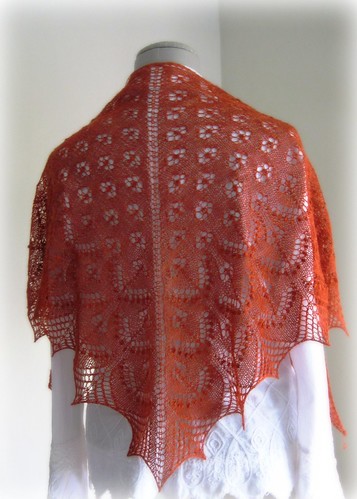
I can’t get great photos and I should not have blocked it (too much time off the couch!). I worked four repeats of the petit pattern and two of the blueberry — the third set of nupps is in the final chart. All of 3 grms of yarn remained — whew! I was sweating those last few rows!
From Sally
I’ve always had a special interest in Estonia because one of my close childhood friends was of Estonian descent. Every Saturday, she and her sister attended Estonian school to learn the language and culture. Anne taught me several words in Estonian, which I still remember all these years later: ema (mother), isa (father), and nupp (pain in the ass button). I was casting around (knitting pun, please groan in unison) for something to knit out of the Atropos I had bought for myself. Susan suggested the Crown Prince Shawl from Knitted Lace of Estonia by Nancy Bush. I had somehow missed this book when it first came out, but I bought it immediately and started knitting. Here is a photo of the shawl from the book.

Now, nupps have the reputation of being a bit of a pain in the button. They’re not difficult, but they can be fiddly; it is easy to miss a nupp loop when you are purling them together and it is also easy to accidentally catch the next stitch while reducing the nupp loops. But they are a hallmark of Estonian knitting and the effect can be lovely as the Crown Prince shawl shows.
Here is a photograph of the yarn I am using: Atropos in the shade Dragon’s Blood. (I just couldn’t resist the color even though I have so much red lace weight yarn in my stash.) The coppery orange skein tossed in is the same color Susan used for her Fylleryd.

From Susan: Sally’s picture captures the orange beautifully
And here is a photo of my Crown Prince in progress. It’s pretty tiny so far. I think I have more of a Baron or Duke than a Prince right now.

So you can see we are well into our nupps and demonstrating lots of sisterly cross pollination of knitting projects!
Stash Reduction Sale!!!
Susan’s Thursdays at 4 Knitting Group is hosting a stash busting sale this Saturday from 9a-4p. All items are a third to half off and there are some fantastic yarns from which to choose! If you are interested in the details, leave a comment requesting information and Susan will email you with the information.
PS: Yes, nuppification is very contagious!
PS2: Patricia mentioned two fabulous shawl patterns: the ever popular Swallowtail by Evelyn Clark and the Percy Shawl by Sanna Kalkman. We have both made the Swallowtail and the Percy is stunning — must be added to queue!
May 28, 2011
From Susan — Pre-Post
I wrote this post pre-operatively to be posted post-operatively! 😉
I knitted up a second Braided Glory immediately after the first. I really enjoyed the pattern and also wanted to experiment with different yarn. I combed the shops and my own thoughts for the perfect yarn and finally landed on Madeline Tosh DK in color Tart — a blackish red that looks exactly like Bing cherries:
I also saw the back of the capelet as a blank canvas, waiting for more to happen. I had already purchased Leaving by Anne Hanson (a gorgeous pattern in queue) and thought the bold lace insert would look great on the back. I adapted it slightly to fit the back. My goal was to look as good “leaving” as I did arriving. ::groan::
Here are the results:
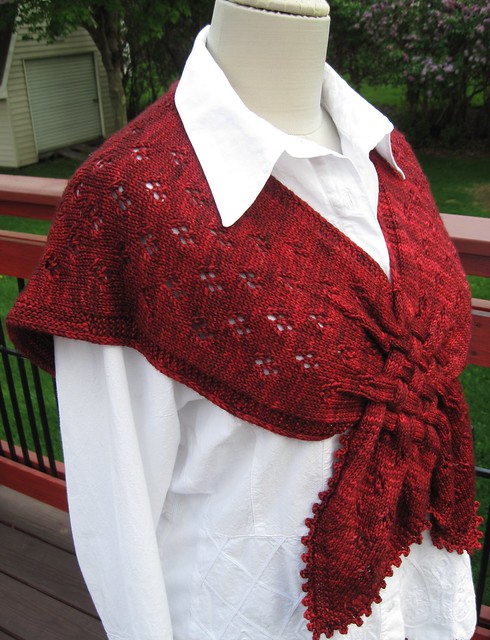
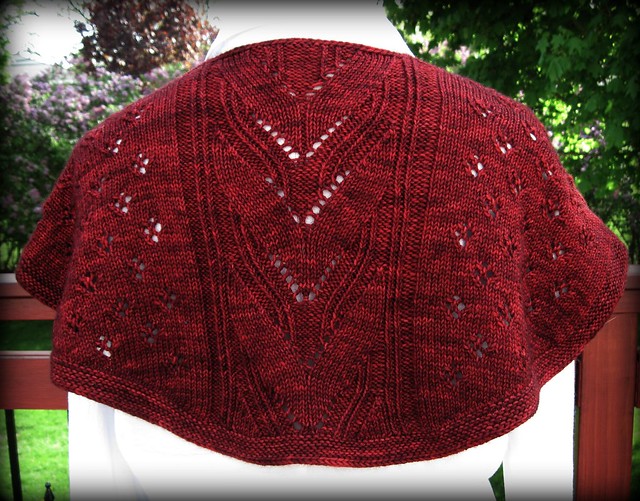
I still used the same “kitten paw” pattern on the sides and fronts — too much thinking to try to come up with something different!
Several of you commented on my previous Braided Glory and said my version seemed less “droopy” than others. That has a lot to do with the yarn. This one, in softer, drapier yarn, is definitely droopier than the one in Nashua Creative Focus Linen. But I think it still works and it fits just like the first one did.
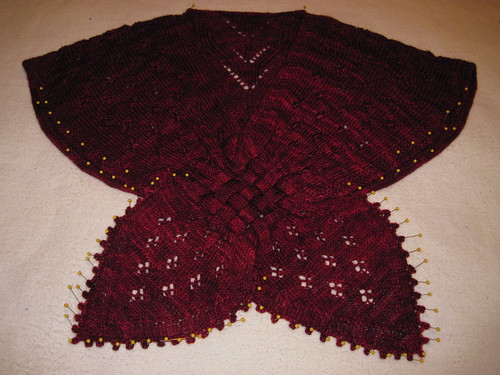
PS: Janet asked about the blocking phase. Here it is being blocked (and it REALLY takes a long time to dry!):
And another shot “in process:”

May 24, 2011
From Susan — Down but Not Out!
My surgery went fine — they did not need to graft additional tendon and so it was a simpler procedure. The nerve block kept me pain free all day yesterday, but I think it is starting to wear off…
I love our readers! Your kind and HELPFUL comments meant a lot to me. Hubby is waiting on me literally hand and foot, but he will need to go to work at some point! One of his co-workers had surgery on the same day I did, so he could not take off a lot of time. I am using a knee scooter instead of crutches (though I do have a pair) and already took a tumble off one of the crazy steps in our house — almost every room is “sunken!” Not a great set up for the old or infirmed!
I am able to knit and I am LOVING my Taygete. Madeline Tosh Light should be considered a controlled subsance! I have a stack of projects to work on so I should be set to go. Thanks for your kind thoughts and well wishes!
PS — Ronna asked for a picture of my knee scooter:

I need to add a basket or something for hauling my stuff…you know me, I do not travel light!
May 22, 2011
From Susan — Start the Pity Party!!
Ugh. You may recall from last year that I injured my ankle when a cup fell out of my cupboard, broke, and hit my ankle right at the Achilles Tendon. The broken cup shaved my tendon like a potato peeler, leaving a small ball of tendon and scar tissue that will not dissolve and causes daily discomfort. Whine. Anyway, I am having surgery tomorrow to debride the damaged tissue and repair the tendon. Sounds simple enough…not. Well, the surgery is probably routine, but the recovery phase is ridiculous!
Two weeks with my foot above my heart for 23 hours a day, with hourly ice packing, and hourly leg pumping to prevent blood clots. Four more weeks without weight bearing. Four more weeks with a walking boot. I am all about putting my feet up and relaxing, but this is just crazy 🙁 .
I have been spending the last few days getting ready for my convalescence — mostly winding balls of yarn!! Thousands of yards of yarn! One must be prepared! 😉
I also started a smallish project that should keep me knitting the first few days: Taygete by Romi Hill (Tay-EE-jet-ay). I purchased some lovely Madeline Tosh Light in Wood Violet and Magenta at Yarnover (from StevenBe). It was supposed to be for gifts for other people.  I looked at the yarns together and fell in love — they were much more eye popping than the combo I bought specifically for Taygete. So, I said to myself, “Self. This is YOUR yarn. You can use it for whatever you want.” The colors positively G-L-O-W in the sunlight! The other yarn has less yardage so I will be hunting for cute shawlette patterns that take < 400 yds., but I have until Christmas to get those done.
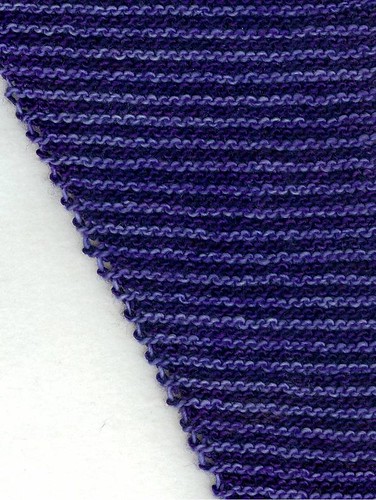
I figure that the first couple of days I will be flat on my back and kind of out of it. I will have my laptop stationed next to me, as well as my instant stream Netflix and a few easy-read novels.
Sally will need to bear the brunt of blogging for a while, so be kind to her while I get back on my feet foot. See ya on the other side!!
Heard yesterday: “They’re making jokes about The Rapture like there’s no tomorrow!”
May 12, 2011
From Sally — Spring (Snow Cardigan) Is Coming
This is just a quick update to say that yes, I am still knitting and not just buying yarn. Please do not come to my house to gawk at the piles of new fiber. Please. (I have not even posted about my Maryland Sheep & Wool purchases. I may never do so in order to protect the guilty.)
I finished the body of my Spring Snow Cardigan a week or two ago. I started the sleeves, but decided to interrupt myself and do the edging and collar so that when the sleeves are finished, there is no other major knitting to do. I’ve got buttons that I think will work out even if they are not the buttons o’ my dreams.
So here is that little tart Lucy wearing the cardigan. As I mentioned before, I am knitting this out of Blue Sky Alpaca’s Royal Alpaca in the color Cameo. (This is a Japanese pattern by Hitomi Shida: Let’s Knit Series Couture #12, but it may be difficult to find).


May 9, 2011
From Susan — Thank You
I’m sure I speak for Sally when I say thank you to everyone for the lovely comments and kind words about our mother. That’s all for now!!
May 8, 2011
From Both of Us — Happy Mother’s Day
If we follow the logic of Sally’s recent post, we are our mother’s FOs! As loyal readers may remember, we lost our mother two years ago right about this time. We both think of her often and her loss left a hole that will never be filled. This is the picture we shared of her from her wedding day:
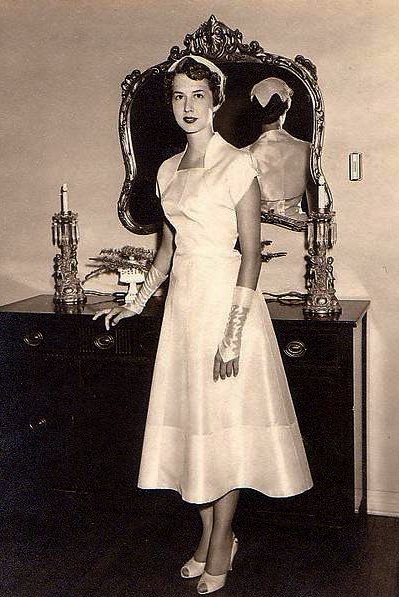
The dress is gorgeous. We brought it back with us, but it had been ravaged by time. The black and white photo above does not do the color justice and you cannot see all of the love and perfection our grandmother put into it. The dress is pale pink organza. Here are some detailed shots:
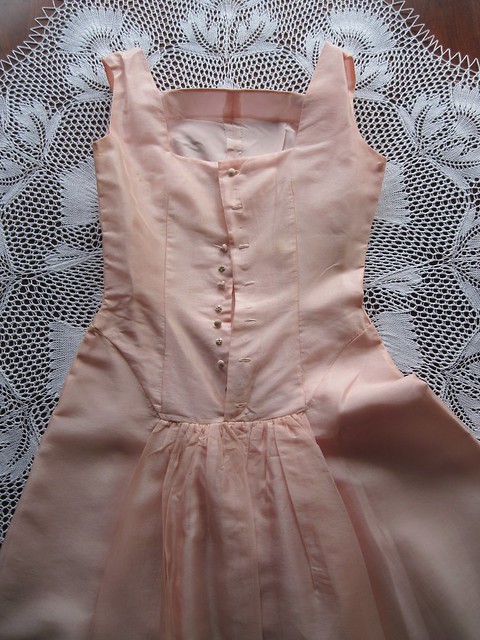
The Back
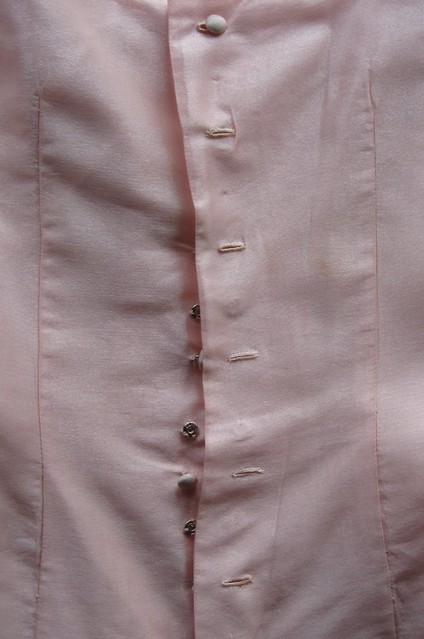
The buttonholes are hand sewn
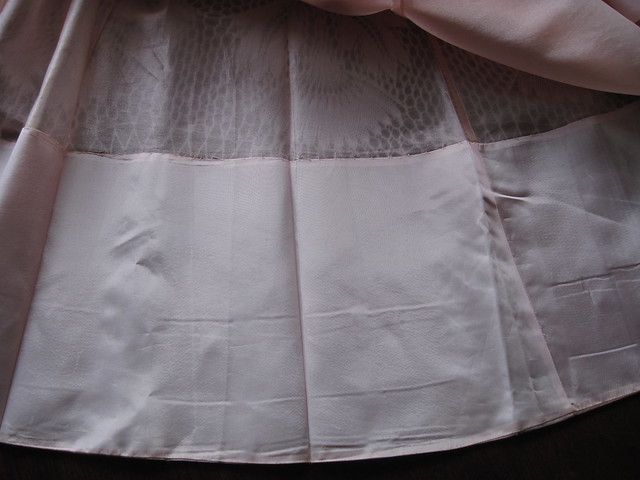
The deep hem
We can’t call our mom today, but she — and both of our grandmothers — are still in our hearts. Happy Mother’s Day to you and yours.
May 5, 2011
From Sally — One of My Greatest F.O.s
Today is my “baby girl’s” birthday; she turns 25. She’s smart, beautiful, and kind. You’ve seen her on these pages modeling some of my creations. E.g.:


She’s a fierce competitor, which I admire very much. Here is a photo of her in last week’s Tour of Gila in New Mexico.

Happy Birthday, Nora!!!
May 4, 2011
From Susan — You Gotta Know When to Hold ‘en
::Groan:: Sally refused to even be associated with a blog post with this title! However, she is represented! These are our “matching” Holden Shawlettes — a beautiful pattern found F-R-E-E on Ravelry! The shawls are a speedy knit, look gorgeous when worn because of the eye-catching scallops, and show off that single skein of sock or fingering weight yarn you bought for the color.
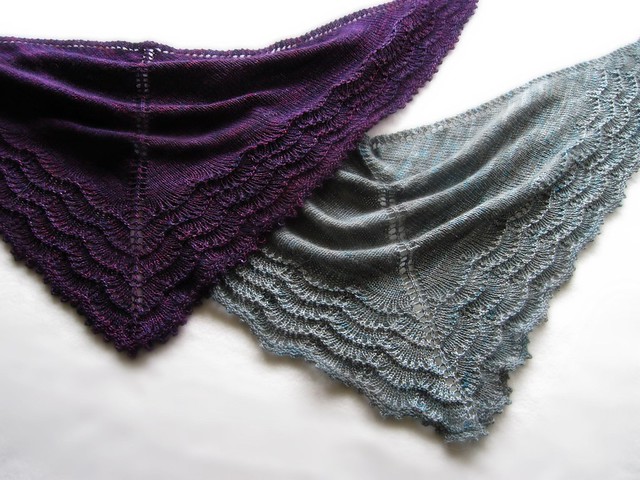
My Holden is knit from Madeline Tosh Light in Color Flashdance (the yarn I bought recently at StevenBe’s — shop hop). Sally’s is in Viola Fancy Sock in the color Sea Storm. Sally and I both did a modification described by others on Ravelry: we stopped 2 rows short before starting the feather and fan chart: 189 sts instead of 193, and then worked all of the pattern repeats in the identical manner (in the original pattern, one repeat has two extra sts = 4 total for both sides). I was concerned with yardage and may not have had enough without the changes. Sally did the same, but had a lot of yarn left over.
I think I will be making a lot more of these as gifts. They are a very quick knit and really show off the yarn and the wearer’s sense of fashion. Fast and beautiful…what more do you want?


