theraineysisters knitting and so much more

July 25, 2006

From Susan — Fair Isle Facts and Fiction

Filed under: Back Story,Oregon Cardigan — lv2knit @ 11:50 am

Knitters are intimidated by fair isle because of its perceived complexity.  Yes, these are challenging projects, don’t get me wrong.  However, they look harder than they are.  The time consuming part of the process is the gauge: usually 30 sts and 36 rows to 4″.   AS’s new yarns knit up to a larger gauge: 28 sts and 32 rows per 4″ — still not what I would call bulky!!  For my size sweater, I am knitting 347 sts every round and each round takes forever!

Facts and fiction:

  1. Oregon uses 17 colors and looks extremely complicated, but in true fair isle, you never knit with more than two colors in any given row.  In Bohus and Norwegian knitting, there are times you knit with up to 4 colors at once.
  2. People are scared off/confused by steeks.  Steeks ( a word that roughly means “gate”) is used to bridge a gap, such as a center front in a cardigan or a sleeve opening, so you can knit in the round while doing color work.  The benefit is that you always knit to create stockinette stitch.  Also, the design pattern is always facing you — you are not trying to figure out where you are in the pattern from the wrong side where the stranding occurs.The steek itself consists of 10 sts of stockinette stitch.  It is just a ~one inch wide strip of knitting strategically placed for cutting after the “tube” is done.  Shaping is done on either side of the steek and magically appears once cut.  As I get to the v-neck shaping on Oregon, you’ll see what I mean.  You carefully cut the steek up the middle (leaving 5 sts on each side) and then finish the cut edges. 
  3. If done correctly, the yarns will not get all twisted together (as in intarsia).  As you knit, you carry one color above and one below.  The yarns run parallel and do not cross each other.  There is no need to twist the yarns together — in fact, DO NOT twist them unless absolutely necessary.  I only twist the yarns for carries across 8 or more sts. I have seen sweaters where the knitter twisted all through the sweater and it looked terrible — the sts get very distorted and the color that is being carried shows through. 

To keep track of the colors, I made a color card with the name and symbol of each color next to a small length of yarn.  Some colors are very similar and difficult to keep straight.  To keep track of where you are in the pattern, use sticky notes — place the sticky edge along the TOP line of the row you are on.  Another thing people use is a magnetic board.  Either way, you need to have a visual line to follow to keep track of your work.

There you have it: Fair Isle 101.  Once you’ve done one of these, it all makes sense!

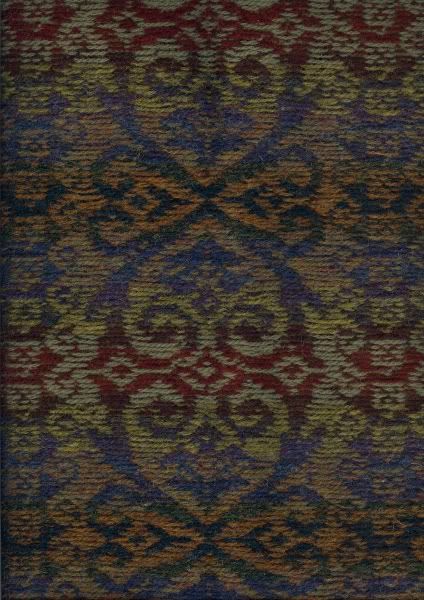
Wendy asked to see the inside of the color work.  I thought I’d share a picture from an already finished sweater because this design really shows the reverse image of the stranding.  Here is the outside (public) view:
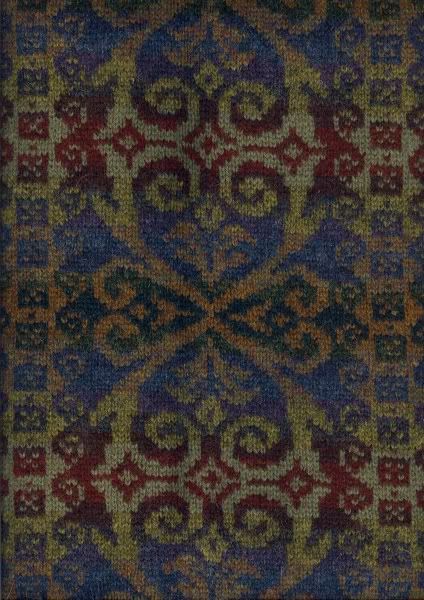
Henriettabackouter.jpg

And the inside:

Henriettabackinner.jpg

This design is Henry the VIII from Tudor Roses.  Now I must knit!
July 24, 2006

From Susan — “The Next Big Thing” is Started

Filed under: Oregon Cardigan — lv2knit @ 3:53 pm

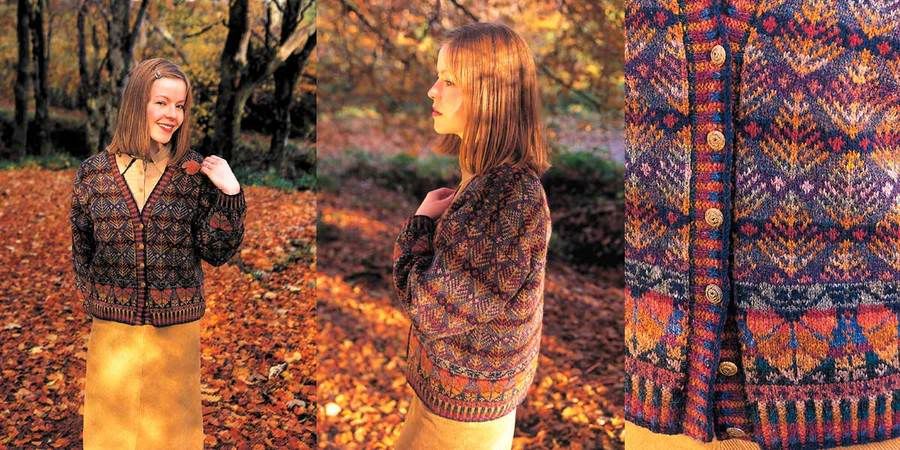
I am a huge, long-time fan of Alice Starmore — probably more like a groupie — and have made several of her sweaters.  She represents the pinnacle of design.  Her patterns are unusually detailed and typically flawless.  Embarking on one of her fair isles is a long journey for me, and a labor of love.  With every stitch, you marvel at the use of color: both in every strand of yarn and the way the colors come together to create the final tableau.  I have had the yarn for this project aging like a fine wine for a few years now.  I am ready for the quest to begin.

oregoncardigan.jpg

I have a particular affinity for this design.  Years ago, I signed up for a two-day workshop on “color” and knitting ganseys.  The yarn shop owner told me I just had to take this class, “The teacher is great,” she said, and I signed up even though I had never heard of Alice at that point.  AS was travelling around the country with her yarn and patterns in tow, teaching workshops to the uninitiated.  The first day, she was wearing the Oregon Cardigan in the original (spring) colorway.  As I sat listening in rapt attention to her every word, I stared at that sweater.  I thought it was incredible and wondered where on earth she got it.  A crazy realization slowly crept over me (like I said, I was truly uninitiated!) — she had knitted it herself.  Not only that, but designed it as well.  I had never seen anything like it and could not imagine knitting anything of that complexity.  Fair isle knitting, with its colorwork and steeks, became the grail.

A few years later, Sally and I went on the knitting tour I mentioned in an earlier post.  AS was one of the instructors.  She taught a half day session on fair isle knitting.  Other than Sally and me, no one in the class had heard of her, like me years before.  To show us how to cut steeks, she cut the sweater shown above — that exact sweater.  So, it became a personal goal for me to knit Oregon.  I love both colorways, but the Autumn really spoke to me.  We also dined with AS the evening before the class.  WOW!  That remains my best knitting moment of all time.

So, I have started Oregon.  I will post a picture soon.  It is a slow go for me and will progress at glacial speed.  This will be my my fourth fair isle.  Once hooked, it is hard to resist the siren call! 

July 22, 2006

From Susan — Post-Op Report on Sunrise Hunchback Surgery

Filed under: Sunrise Circle Jacket — lv2knit @ 1:58 pm

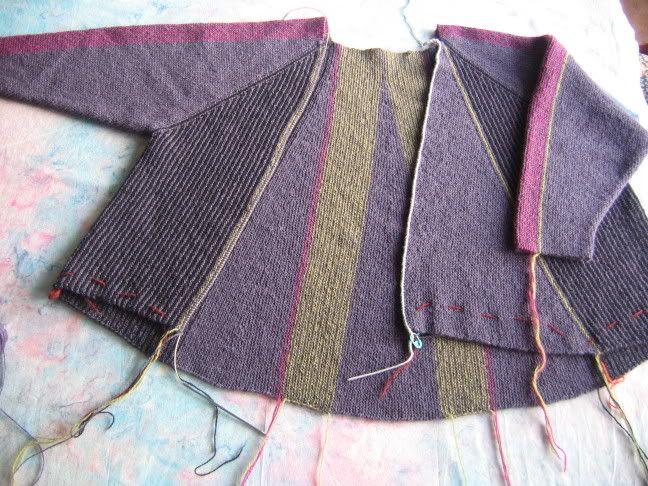
Whew, it was touch and go there for a while, but Sunrise pulled through.  The hump appears to be a thing of the past.  Sunrise is recovering nicely. 

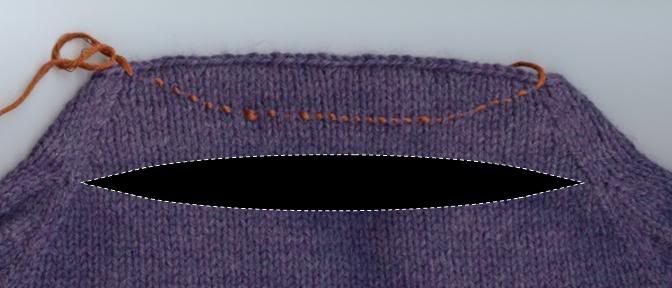
Ideally I should have taken the extra fabric out as follows, but it would have meant a LOT more work:

Slide1-1.jpg

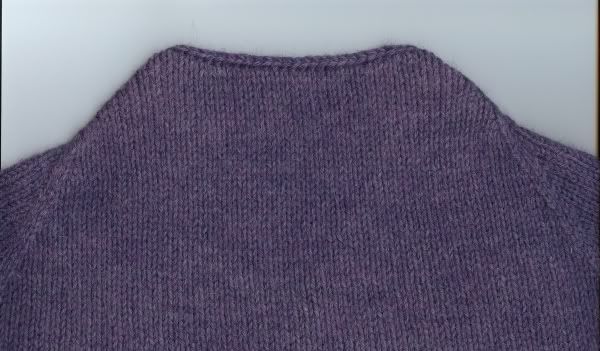
Instead, I took the extra length from the top along the basting line.

SunriseFinishedBackOuter-1.jpg

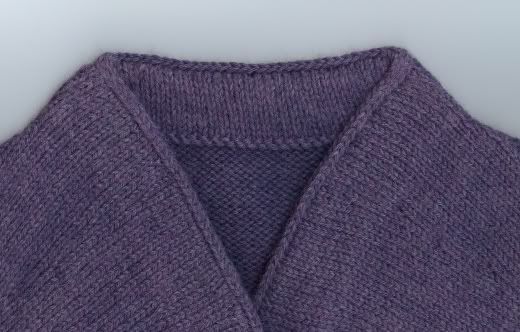
From the inside:

SunriseFinishedBackInside-1.jpg

I dismantled the I-cord, machine stitched along the basting line, and trimmed off the excess.  I then picked up sts, re-knit the I-cord and tacked down the cut edge.  After that, I grafted the facing back onto the I-cord. 

I wouldn’t recommend doing it this way if you can avoid it!  I have a couple of things in my favor:

  1. I know how to sew
  2. It does not bother me in the least to cut knitting
  3. I do not mind grafting, Kitchener — whatever you want to call it — in any of its forms

Most people do not like to cut OR graft.  What I would have done differently is to shape the back neck as I was knitting the garment.  That’s where the designer comes in.  And as I said before, I am not faulting her.  She designed an incredibly unique and fun project.  You often don’t know what the fit issues will be until after the garment is constructed.


July 3, 2006

From Sally — Feather and Fan Shawl Update

Filed under: Feather and Fan Shawl — Sally @ 6:34 pm

We’re ba-a-a-a-ack. I’ll do a longer post soon (and so will my sister if her internet ever starts working again) about our trip and our many yarn finds and adventures. In the meantime, I’ll just show you my progress on the Feather and Fan shawl from A Gathering of Lace. Here is a photograph taken as I transfer it to a larger needle. It will, of course, look much better once it’s blocked but you can see the floral pattern in the center. At this point, I have about 480 stitches on the needles. When I’m at the point of casting off, I’ll have over 1,300. So, although it’s a very easy pattern from a knitting point of view, it is slow. It’s a project I’ll pick up and put down depending upon my mood.

June 23, 2006

From Sally — How Many Shawls Are Enough?

Filed under: Feather and Fan Shawl,Knitting Tips — Sally @ 2:26 pm

I do have a recent thing about shawls and shawl knitting. I’ve already started yet another one. My latest project is the Feather and Fan Shawl from Meg Swansen’s A Gathering of Lace. This particular pattern was designed by Eugen Beugler. Here is a photograph of the shawl as seen in the book.

As you can see, it’s a circular shawl. You start knitting it from the center out. I’ve gotten just past the point where I could transfer the knitting to a circular needle.

I hear you muttering. “What the hell is she doing knitting yet another grey shawl? Is she nuts?” Don’t answer that. In my defense, this is yarn from my stash. Well, it’s yarn that was put in my stash recently during the yarn store close out sale. It’s the same yarn used in the book, a rarity for me, and it was very inexpensive. It’s Jamieson & Smith’s laceweight yarn and it’s surprisingly nice to work with.

It’s a relatively simple pattern once you get going — when I get to the main part of the shawl, there is patterning on every fourth row only. In other words, there will be three rounds of plain knitting, which makes this a portable and relatively mindless project. I am doing a slight variation of the shawl that is described in the book without, unfortunately, a good photograph to show you. In my variation, every third patterned segment on the main part of the shawl will be an eyelet cable pattern instead of the classic feather and fan.

The only tricky part of this shawl (and this is true of any of the square or round shawls knit from the center out) is getting started. I think I must be the least dexterous person on the planet — I have trouble getting a circle started on four needles when I only have two stitches on each needle. It’s fussy and futzy and annoying. Here is my method for anyone interested.

1. Circular cast on

You don’t have to use a special circular cast on, but I have found that it looks slightly nicer at the end. So I use the famous Emily Ocker cast on method. Here is a link to what I think is a good explanation (with good photographs) of how to do it.

Circular Cast On

Casting on doesn’t solve the problem of how to start knitting in the round on double pointed needles. I’ve tried everything from trying to arrange them on a table to throwing them at the wall after they get twisted and I get frustrated. (I don’t have a problem with socks or anything else that has a fair number of stitches. The difficulty comes from having so few stitches to work with when you are starting a shawl.) I’ve also tried the knitting with two circular needles method, but found that to be a bit clumsy and awkward with so few stitches as well.

So, I use the Magic Loop method.

2. Magic Loop Knitting

Magic Loop knitting is not something you necessarily want to do a lot of, but it works really well for starting a circular or square shawl. I knit using this method until I have enough stitches (after the increases that are a normal part of the shawl pattern) that I can distribute 8-10 stitches on each needle. I meant to take some photographs of this shawl at this stage and right after the transfer to the double pointed needles, but I got caught up in the knitting and forgot. Oops. However, I did find this handy video you can watch of how to do Magic Loop Knitting. It’s very clear; if you haven’t done it before I think this video is a great reference. If you search around on this site, she has videos on other techniques as well so you may want to bookmark it.

Magic Loop Knitting

Scroll slightly down. The Magic Loop technique is listed under Small Diameter Circular Knitting (along with other techniques). All you have to do is click on the video icon and the video should start automatically.

June 21, 2006

From Sally — Icarus Shawl Completed

Filed under: Icarus Shawl — Sally @ 5:54 pm

It is finished — blocked and already dry! It is a beautiful pattern and the finished shawl feels light as air. Without further ado, here are some photographs of my Icarus.

Being cast off:

Being blocked:

Here it is being modeled (somewhat reluctantly) by my daughter in the garden:

We were having trouble taking good photographs because we had a “helper”:

Here are several closeups of the “point” of the shawl. The first was taken before it was blocked.

The second two were taken after blocking.

One reason I was drawn to this particular shawl, besides how striking it looked in Interweave Knits, was my long fascination with the myth of Icarus. As part of the feel free to scroll portion of the blog (now that you’ve seen the photographs of my finished piece), I’d like to share one of my favorite poems. It’s called Musee des Beaux Arts, by W. H. Auden. It was inspired by Breughel’s painting of Icarus falling into the sea (you can just barely see his legs in the water).


“Fall of Icarus” by Breughel

About suffering they were never wrong,
The Old Masters; how well, they understood
Its human position; how it takes place
While someone else is eating or opening a window or just walking dully along;
How, when the aged are reverently, passionately waiting
For the miraculous birth, there always must be
Children who did not specially want it to happen, skating
On a pond at the edge of the wood:
They never forgot
That even the dreadful martyrdom must run its course
Anyhow in a corner, some untidy spot
Where the dogs go on with their doggy life and the torturer’s horse
Scratches its innocent behind on a tree.
In Breughel’s Icarus, for instance: how everything turns away
Quite leisurely from the disaster; the ploughman may
Have heard the splash, the forsaken cry,
But for him it was not an important failure; the sun shone
As it had to on the white legs disappearing into the green
Water; and the expensive delicate ship that must have seen
Something amazing, a boy falling out of the sky,
had somewhere to get to and sailed calmly on.

June 20, 2006

From Sally — Icarus Shawl update

Filed under: Icarus Shawl — Sally @ 11:43 pm

I’m finished. Sort of.

I’ve finished all of the knitting and have just started to cast off. It’s late, and casting off will take a long time. I think I’m going to go to bed and not worry about it until tomorrow. Otherwise, I’ll be up half the night (especially since I wouldn’t be able to resist the temptation of starting to block it).

I’ll post pictures tomorrow of it once it’s partway off the needle, as well as pre- and post-blocking.

From Susan — Sunrise Oval Jacket

Filed under: Sunrise Circle Jacket,Updates — lv2knit @ 6:32 am

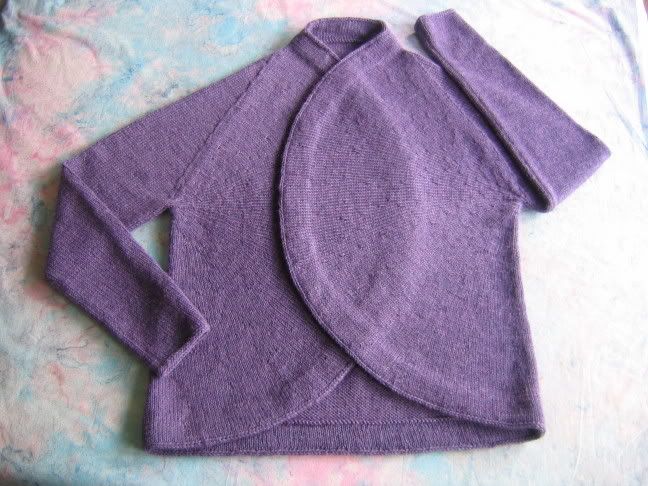
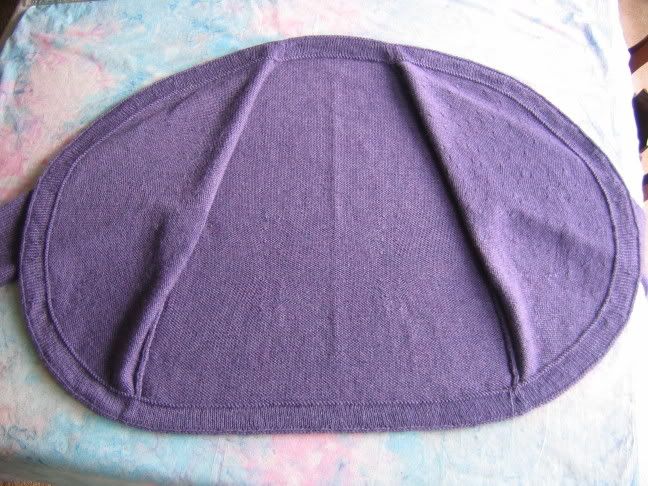
I have been too busy to get my Sunrise blocked, but I thought I would share some pictures of it anyway.  It is such a cool pattern, and I enjoyed making it very much.  I love things that are a little different — classic yet unique — and this certainly qualifies. 

MultiPics001.jpg

Here is the “oval”:

MultiPics003.jpg

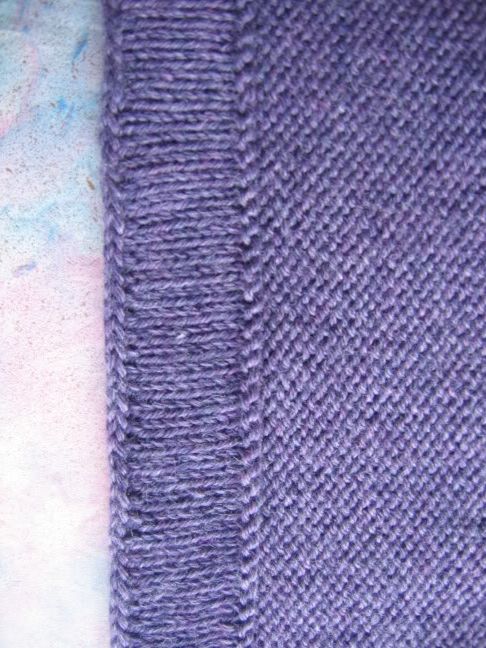
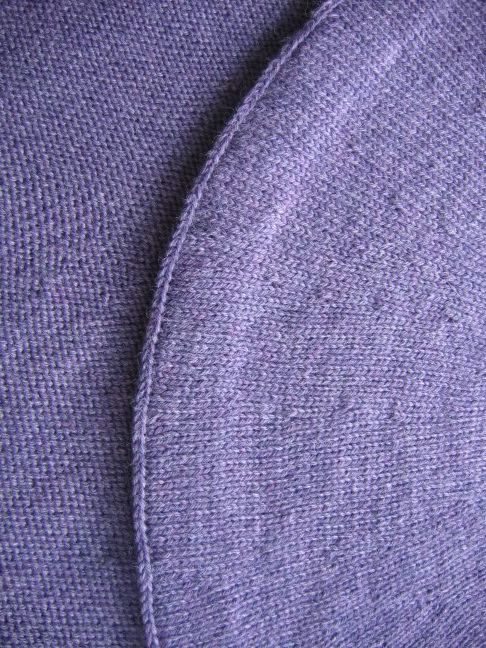
Here are some detail pictures:

Hem

MultiPics004.jpg

Left front

MultiPics005.jpg

I also spent some time on Ballerina.  I recommend that if you make this jacket, you keep some notes or something.  My two sides are not what I would call perfectly symmetrical.  It’s not something you can see really, but I did need to fudge to get the numbers to work out, and I have no idea why.  The stitch count is the same, so either Hanne designed it with the sides a bit off, or I am a bit off.  Don’t answer that!

MultiPics006.jpg

I am still toiling on my scarf and the wedding ring purses will be done this evening — pictures of them tomorrow…

June 17, 2006

From Susan — A Multi-Tasking Update

Filed under: Sunrise Circle Jacket,Updates — lv2knit @ 9:41 am

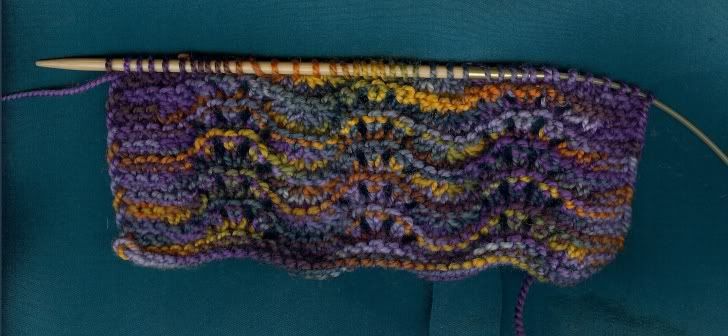
As Sally was quick to point out, I had a birthday.  I left work early and spent my afternoon lurking in yarn stores.  I stopped by Borealis – in St. Paul – and asked them if I could hang around and knit.  They were very pleasant about it.  There is a scarf in the shop that I have loved since I first saw it.  It is a simple feather and fan pattern made with Cherry Tree Hill sock-weight merino in the color African Gray.  It has every color in the rainbow, predominantly purple and orange (!).  What on earth will THAT go with?  I bought the $22 skein, which actually makes TWO scarves (one for me, and yarn for Sally) and threw it in with my Sunrise Circle Jacket – it is perfect with it!  I think it will actually go with a lot of stuff because it has so many colors in it.  Here is the start of the scarf:

featherandFanScarf.jpg 

I also did finish the Sunrise Jacket.  I think it turned out.  I will need to get the buttons (there’s no rush, so I’m going to be picky), but I think it fits and looks good.  I am going to block it one more time for good luck.

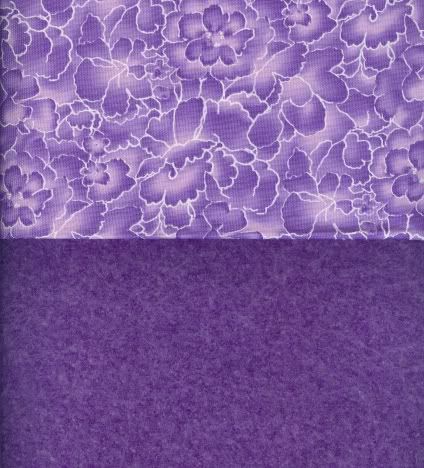
Laura wants me to line her felted purse and include a zippered pocket.  Here is the lining she chose:

Purse Lining

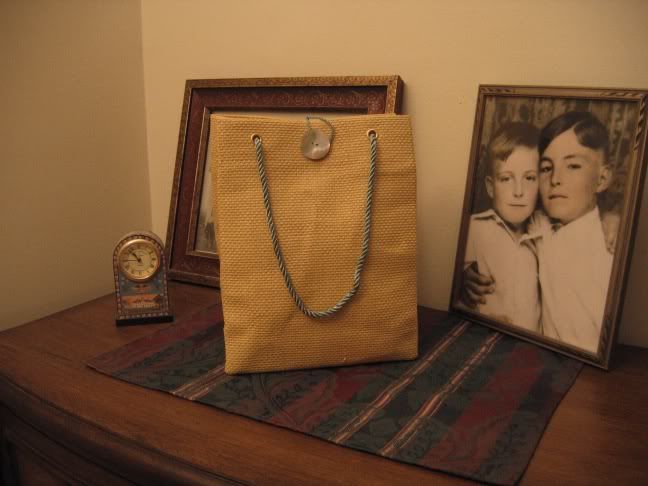
For my birthday, my two girls got me some very nice gifts.  The toiletries came in the cutest knitting bag!  I was more excited about the bag than the lovely lotions etc.  It is absolutely perfect for small projects and right now I have 3 going; beaded purse, wedding ring bag, and scarf.  All three will travel in the new bag for

varietal knitting!

IMG_3862.jpg

From Sally — Icarus Shawl update

Filed under: Icarus Shawl — Sally @ 7:13 am

I’ve just started the fourth, and final, lace chart on the Icarus Shawl. It’s difficult to see the pattern in these photographs because the lace is not yet blocked and because of the fuzziness of the Kidsilk Haze (before blocking). It’s interesting how different the color looks in these two pictures. One was taken with a flash and one was taken in natural lighting. The true color of the yarn is somewhere in between. The fourth lace chart has more rows than the others and, with 500 stitches or so per row, it’s slow even though the lace pattern itself is relatively simple. I should, however, find the time to finish it within the next few days.

« Newer PostsOlder Posts »

Powered by WordPress